
Thanks to technological development, it is possible to streamline many production processes, regardless of the industry in which a company operates. Your company will certainly experience improved quality and increased work speed through the robotization of tasks such as palletizing. An element used in this area is autonomous mobile robots. See why it is worth implementing them in your company.
What Are Autonomous Mobile Robots?
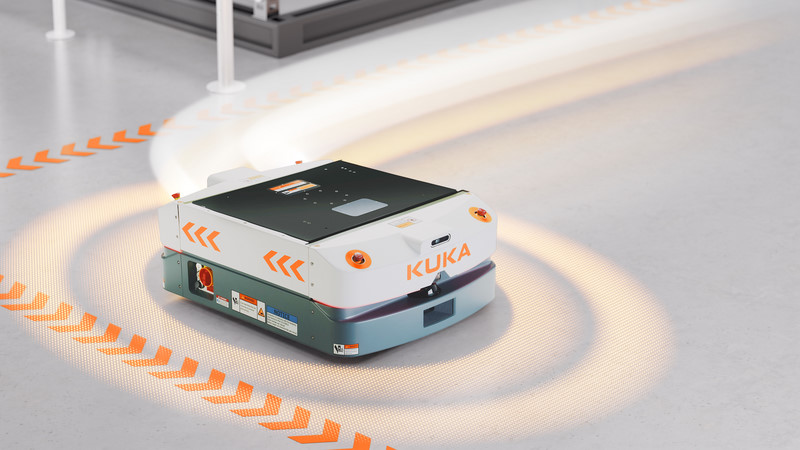
Autonomous transport carts are referred to as AMRs, from the English term Autonomous Mobile Robot. They have a design that allows them to carry pallets. They are equipped with a drive system and advanced technological solutions that enable them to move autonomously within a given space. To move independently, AMRs use sensors, 3D cameras, and control computers. Thanks to these advanced solutions, autonomous mobile robots can navigate an industrial environment, creating new paths if needed to avoid obstacles. They can also adjust their speed according to conditions and requirements, and manage their energy balance. Most AMRs are battery-powered, and recharging the battery takes only a few dozen minutes at a special automatic charging station. As a result, these are palletizing robots increasingly used by companies across various production sectors.
What Are the Advantages of AMR Robots?
Thanks to its advanced navigation systems, an autonomous transport vehicle is capable of moving completely independently, without the involvement of an operator or driver. Many other automated production solutions require modifications to the floor and the creation of specific tracks for the devices. However, this is not necessary when an AMR robot is operating in the production hall.
A very important advantage of these machines is the ability to tailor their capabilities to the specific needs of a company. They can be designed for a particular load capacity or the width of work aisles. The most efficient models are capable of carrying loads exceeding even one ton. An AMR robot can also be integrated with other technical solutions used in a given production space. It can work in conjunction with conveyors or automatically operated gates. It can successfully replace traditional forklifts or serve as a functional complement to them.
Autonomous Transport Vehicle for Your Company
An autonomous transport vehicle, like any other industrial robot, should be individually designed to meet the needs of a specific company. The design is a crucial stage of the investment because it allows solutions to be adapted to the existing operational conditions in a given space, as well as to the specifics of the transported products or materials. This way, it is possible to take full advantage of all the benefits that autonomous transport vehicles offer.
The most important benefit for many companies is the increase in production capabilities. The speed of tasks and the throughput of individual elements of the production process improve. As a result, the company can experience the impact of the investment in the form of tangible financial gains.
In addition, the autonomous transport vehicle contributes to optimizing the use of human resources. Employees can be reassigned to other, more developmental positions. Palletizing itself then requires less human involvement—rather than physical labor, it is sufficient to have personnel supervising the robots’ work.
In the context of human labor, no less important is the improvement of safety. The palletizing process often requires personnel to perform their duties under difficult conditions—working under tight time constraints and handling heavy loads. This, in turn, always increases the risk of workplace accidents, even when all safety standards are observed.
Finally, it is also worth mentioning the environmental aspect. AMR robots contribute to optimization in terms of resource consumption, such as electricity. This issue is increasingly important not only for financial reasons but also for branding and marketing purposes.


